Smoking Gun 1: POTUS Andrew Johnson (D) # 17, Veto of US Citizenship For Chattel Slaves
READ and COMPREHEND: The SOON-TO-BE-RELEASED ONLINE BOOK
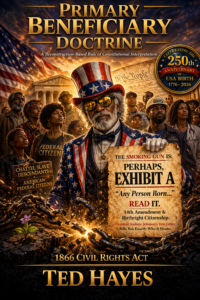 US President, the Hon. Mr. Andrew Johnson #17, (Democrat), the former Vice President of the assassinated on April 14th, 1865, Hon. Abraham Lincoln (not the 14th), speaking in the name of constitutional duty and obligation to “the whole people” of America, tried by veto power to defeat the 1866 Civil Rights Act (The Act).
This was/is the Congressional Act of the 29th, 1854-56 Republican Party-led Congress that granted a unique and highly powerful US super citizenship status, with certain remedial designs specifically prescribed for military-liberated, formerly enslaved Freedmen.
But in explaining why he opposed it, Mr. Johnson repeatedly identified the very people for whom The Act—and later the Fourteenth Amendment’s opening citizenship language—was, originally, initially, and always was designed.
In that sense, Johnson’s veto message operates as an inadvertent admission against interest: he names the intended protected class.
Far from describing a universal immigration rule, his message is saturated with references to the formerly enslaved, the “colored race,” “excepted races,” “Freedmen’s Bureau,” and the relation between “white” and “colored” persons.
By his own words, the bill was aimed at the condition of African-descended chattel slaves newly emerged from bondage and their legal elevation into equal civil status.
Ironically, then, President Andrew Johnson became Exhibit A for identifying the proper subject beneficiaries of the Civil Rights Act of 1866 and, by extension, the Reconstruction citizenship guarantee that followed
You could also cast it in a more legal style:
Johnson’s Veto as an Admission of the Protected Class
Although President Andrew Johnson vetoed the Civil Rights Act of 1866, his veto message is powerful evidence of who Congress understood itself to be protecting.
His objections do not describe the bill as a measure for immigrants generally, nor for all persons everywhere in the abstract.
Instead, he repeatedly frames it in racial and post-slavery terms: “excepted races,” the “entire colored population,” persons who had “just emerged from slavery into freedom,” legislation “in favor of the negro,” the relation of “white” and “colored races,” and the work of the “Freedmen’s Bureau.”
The Freedman’s Bureau is another “fatal bullet” point that also identifies the “Any persons born…” as those who, it is now purportedly claimed, can’t fit within its parameters, demonstrating their unqualification.
These repeated formulations identify the statute’s target population as the freedmen class and their descendants in the constitutional transition from slavery to citizenship.
Thus, Johnson’s veto message, though hostile to the measure, functions as highly probative evidence of the Act’s intended subject beneficiaries.
And if you want a punchier public-facing formulation:
The irony is stunning: in trying to stop the Civil Rights Act of 1866, Andrew Johnson ended up naming and affirming its true beneficiaries over and over again.
Not immigrants. Not “anchor babies.” Not a borderless theory of birthright.
His own veto message points to the freed slaves, the colored population, the races formerly excluded, and the Black-white legal divide created by slavery.
He meant to resist the measure, but in doing so, he described exactly who it was for. Case closed. Checkmate. Match Point. Fete comple’
Johnson identified the subject beneficiaries at least fifteen times in his veto message, including by references to:
- “the several excepted races”
- “entire colored population and all other excepted classes”
- “Four million have just emerged from slavery into freedom”
- “give like protection and benefits to those for whom this bill provides special legislation”
- “in favor of the negro”
- “to be enjoyed by these classes”
- “as is enjoyed by white citizens”
- “equality of the white and colored races”
- “any power of discrimination between the different races”
- “State laws discriminating between whites and blacks… between the two races”
- “without regard to color or race”
- “discriminating protection to colored persons”
- “the Freedmen’s Bureau”
- “the colored race” and “for the white race”
- “the distinction of race and color” and “the colored and against the white race”
No comparable language in the veto message identifies immigrants as the intended beneficiary class.
The message is race-conscious, slavery-conscious, and Freedmen-conscious throughout.